
Every contract renewal, every annual general meeting, and every lift breakdown tends to surface the same uncomfortable questions for the people who run Singapore’s buildings. Who is legally allowed to service this lift? What happens if something goes wrong? And how does a management committee actually prove it picked the right lift maintenance company in Singapore?
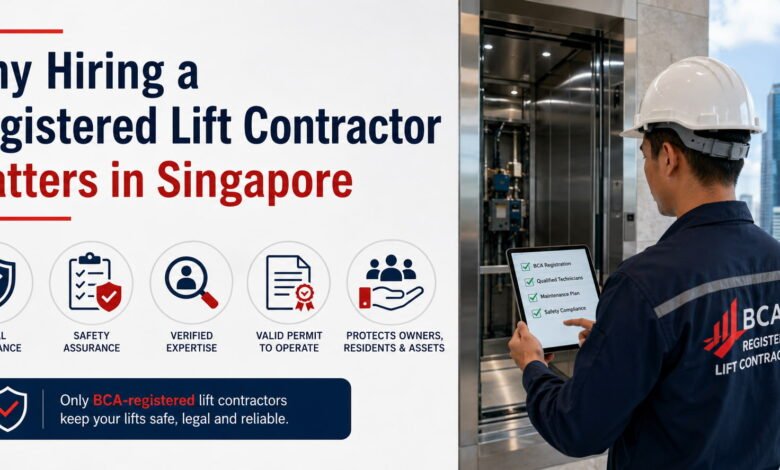
Why Hiring a Registered Lift Contractor Matters in Singapore
For MCST members and property managers, these are not abstract concerns. The country’s building control framework places the legal weight of lift safety squarely on the owner, and getting the contractor decision wrong can carry consequences that range from a void insurance policy to personal exposure after an incident.
What registration actually certifies
In Singapore, the Building and Construction Authority decides which companies may carry out lift maintenance, alteration, or replacement work. Under the Building Control (Fixed Installations) Regulations 2025, only a BCA-registered contractor can legally touch these systems, and that registration is awarded at the company level after the authority is satisfied the firm has the technical competence, qualified staff, and insurance cover the work demands. The assessment exists for a blunt reason: a neglected lift is a direct danger to the people who use it.
One detail trip up owners more than any other. Registration carries an expiry date and can lapse or be suspended. The moment it does, the company is barred from working on your lift until it is reinstated. Treating a registration as permanent because it was valid when the contract was signed three years ago is exactly the assumption the regulations are designed to catch out.
Verification takes minutes and protects committees
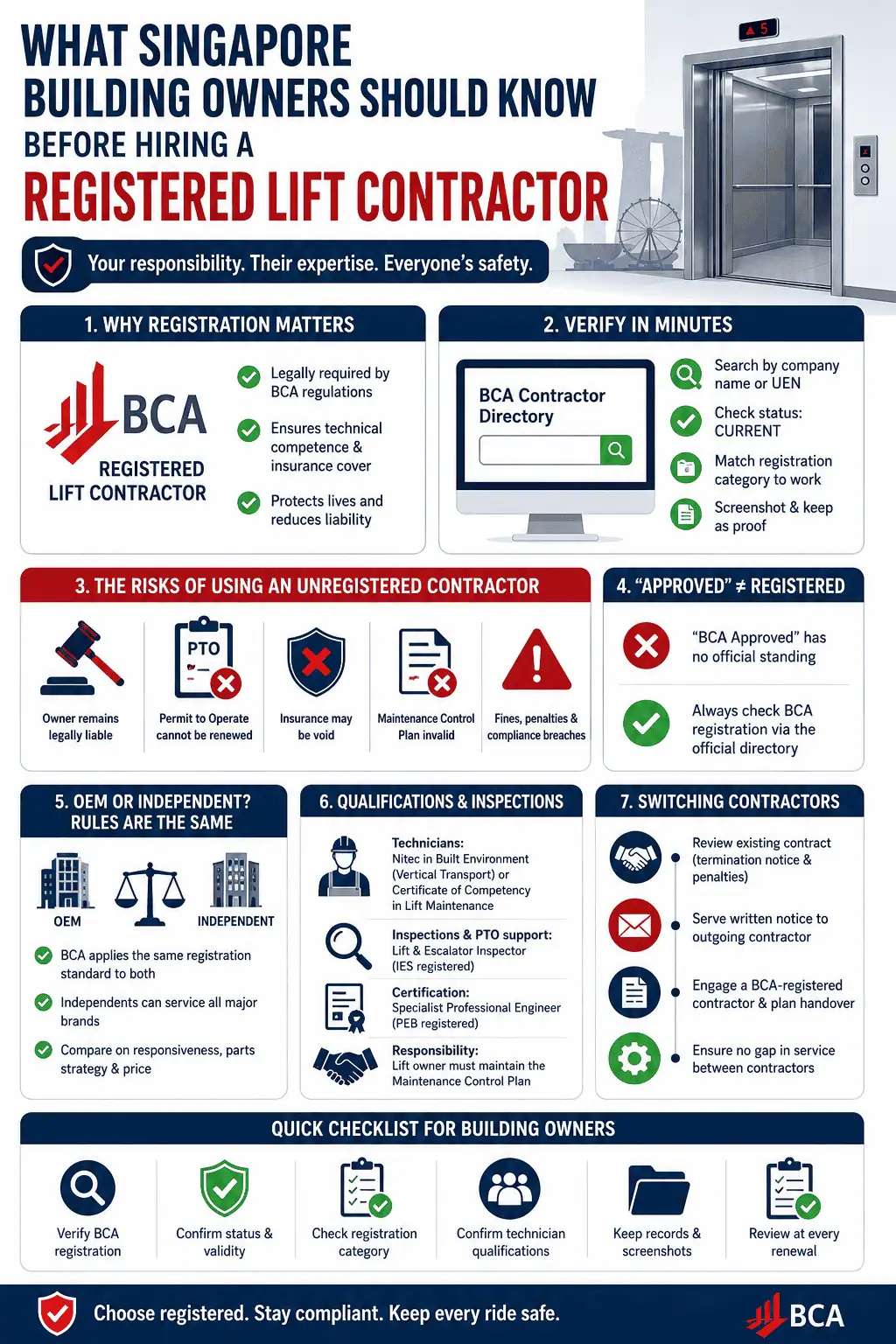
The authoritative way to confirm a contractor’s status is the BCA’s online contractor directory, which lists every registered lift firm by company name and Unique Entity Number. A printed certificate, a logo on a website, or a salesperson’s reassurance is not evidence.
The directory takes under five minutes to search, and it is worth confirming two things while you are there: that the status reads as current rather than expired, and that the registration category matches the work you need. Maintenance and alteration or replacement are separate categories, and a firm may hold one without the other.
Good governance goes a step further. Committees that screenshot the directory result, note the search date, and file it with the maintenance records build an audit trail showing due diligence was done. Repeating the check at each renewal closes the most common gap of all, since a registration that was current at signing may not have survived to the next cycle.
The cost of engaging the wrong firm
Using an unregistered contractor carries weight well beyond a paperwork slip. The legislation names the building owner as the responsible party, so liability doesn’t transfer to the contractor if an incident occurs, and “we didn’t realise the registration had lapsed” offers no shelter.
There is a compliance dimension too. The Permit to Operate that certifies a lift as fit for use cannot be renewed on the back of work done by an unregistered party, which can leave a building running without a valid permit, an offence in its own right.
The financial exposure can be just as sharp. Insurance covering lift incidents typically assumes maintenance was performed by a properly registered firm, so work by an unregistered party may void the policy and leave the building carrying uninsured risk.
The Maintenance Control Plan that BCA requires for each lift also has to name an accountable registered contractor; an unregistered one cannot fill that role, and a mid-contract loss of registration obliges the owner to replace the firm and update the plan.
“Approved” is not the same as “registered”
Contractor marketing sometimes leans on the phrase “BCA approved.” It has no formal standing. There is no separate approval scheme for lift contractors distinct from registration and accepting the claim at face value risks hiring a firm that is not actually on the registry.
Other credentials add useful context without replacing registration: bizSAFE, run by the WSH Council under the Ministry of Manpower, speaks to safety management rather than lift competence, and professional affiliations such as IES membership are meaningful but are not a substitute. The reliable approach is to ask for the BCA registration number and UEN, then check the directory directly.
Independent or OEM, the rules are identical
Owners often ask whether they can move from an original equipment manufacturer’s service arm to an independent specialist. They can. BCA applies the same registration standard to both and does not favour the manufacturer of the lift.
Independents that work with non-proprietary systems rather than brand-locked parts can service equipment from every major brand, including Schindler, Otis, KONE, Mitsubishi, Fujitec, TKElevator, and Toshiba.
Building owners weighing lift maintenance services by Hin Chong or another independent against an OEM offering will find the regulatory bar is the same for each; what differs is parts strategy, responsiveness, and price.
A switch is mostly contracting management. Review the existing agreement for its termination notice, commonly 30 to 90 days but sometimes longer, and any early-exit penalties. Serve written notice, request quotes from registered independents, and arrange a clean handover of records, lift-room access, technical documents, and any on-site spares.
Crucially, coordinate the changeover so there is no gap between the outgoing firm’s last visit and the incoming firm’s first scheduled service, since an un serviced stretch is both a compliance and a safety risk.
Qualifications, inspections, and where responsibility sits
At the technician level, the baseline credential is either a Nitec in Built Environment (Vertical Transport) or a Certificate of Competency in Lift Maintenance. These apply to individuals, not the company, so it is entirely fair to ask which technicians will be assigned to your building and whether each holds a current qualification.
Periodic inspections and Permit to Operate support involve a Lift and Escalator Inspector registered with the Institution of Engineers Singapore, while the certification itself must be signed off by a Specialist Professional Engineer registered with the Professional Engineers Board.
Alteration and replacement work carry further approvals under the 2025 regulations, which replaced the Building Maintenance and Strata Management Regulations 2016 from October 2025.
Underlying all of this is the Maintenance Control Plan, and the responsibility for keeping it current rests with the lift owner, not the contractor. The firm executes the plan; the MCST ensures it exists, names the right registered contractor, and is actually being followed.
Established independents such as Hin Chong, which has held BCA registration under UEN 199901705H, should be able to explain what a building’s plan requires and whether the current program satisfies it. A contractor who has never raised the subject is one worth examining more closely.
Post you might be interested
- Your Gallery Lighting Demands More Power Than You Think
- Essential Types of Dampers and Their Practical Applications

Brooke Garne is a passionate writer and the Chief Editor at Post Directory, with a keen eye for detail and storytelling. She specializes in crafting engaging, informative content that delivers real value to readers. With a focus on clarity, authenticity, and research-driven insights, Brooke helps audiences better understand complex topics while keeping content accessible and relatable.