
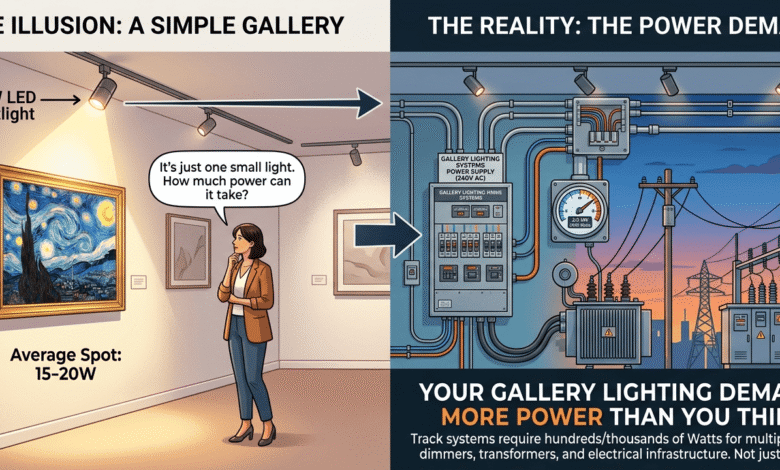
Gallery-grade lighting is entirely different from what you find in a standard office or retail space, and underestimating it leads to problems that are expensive and disruptive to fix. If you are fitting out a gallery, exhibition space, or showroom in Singapore, the electrical infrastructure behind your lighting deserves more attention than it typically gets. The choices you make here do not just affect how the work looks – they affect whether your space can actually function the way you need it to on opening night and every night after.
Why Gallery Lighting Is Not Just “More Lights”
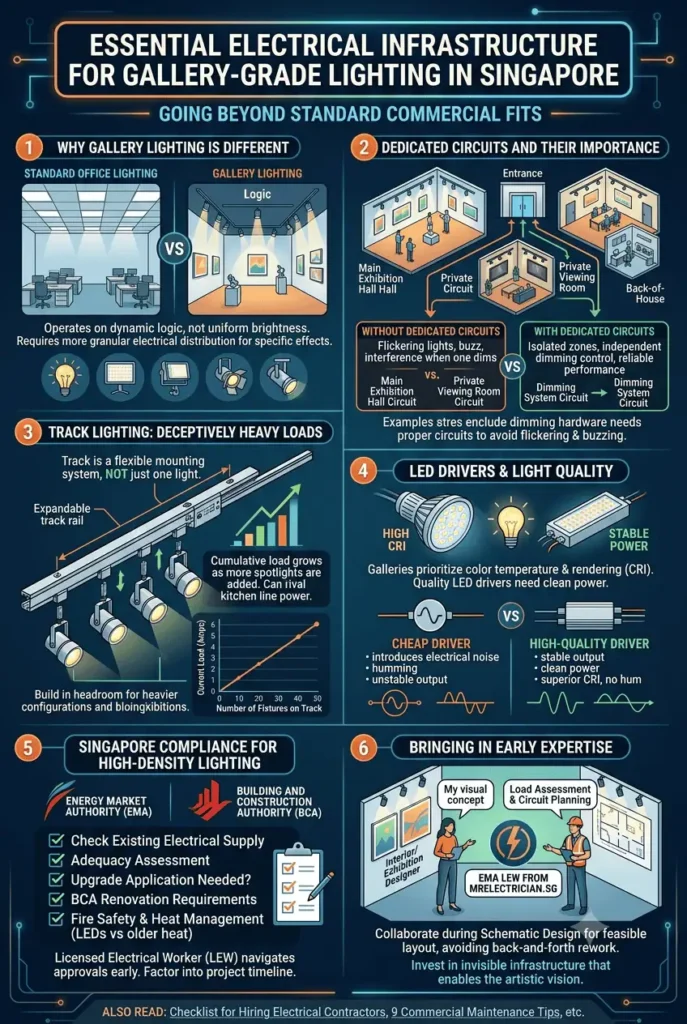
A typical commercial space uses general overhead lighting – uniform, functional, designed to make a room bright enough to work in. Gallery lighting operates on a completely different logic. Every fixture has a purpose. Track-mounted spotlights pick out individual pieces. Wash lights illuminate feature walls from calculated angles. Display cases have their own internal lighting with colour temperature requirements. Accent lighting creates depth and directs attention.
The result is a space with far more individual light fixtures per square metre than a standard commercial tenant would ever need, each one drawing power and each one on a circuit that needs to be properly sized and protected. And because the lighting is not uniform – some zones are brightly lit while others are deliberately dim – the electrical distribution needs to be more granular than a simple daisy chain of overhead fittings.
Honestly, this is one of those things that gets overlooked until someone is standing in the half-finished space wondering why the electrician is talking about additional circuits. The answer is almost always that the lighting layout demands more from the electrical system than the original plan accounted for.
Dedicated Circuits and Why They Matter Here
In a standard fit-out, you might run lighting across a few general circuits and call it done. In a gallery, that approach falls apart quickly.
Different zones need to be controlled independently. Your main exhibition hall, your entrance foyer, your private viewing room, and your back-of-house areas all have different lighting requirements and different usage patterns. If they share circuits, you cannot dim one zone without affecting another. You cannot isolate a section for after-hours events without powering down spaces that need to stay lit.
Then there is the question of dimming systems. Track lighting on a dimmer draws power differently from a fixed-output fitting. Dimming hardware – whether trailing-edge, leading-edge, or digital addressable – introduces its own electrical requirements, and not every circuit configuration plays nicely with every type of dimmer.
Getting the wrong combination results in flickering, buzzing, or fixtures that simply refuse to dim smoothly. Any experienced gallery designer has a story about a dimming system that looked perfect on paper and behaved terribly in practice because the electrical side was not set up to support it.
This is where you start to see why galleries need their electrical plan built around the lighting design, not the other way around. The lighting is the primary function of the space. Everything else – the climate control, the security system, the point-of-sale setup – is supporting infrastructure. But the electrical plan needs to treat lighting as the main event and allocate circuits, capacity, and control infrastructure accordingly.
Track Lighting Loads Are Deceptively Heavy
Track lighting is the backbone of most gallery installations. It offers flexibility – you can reposition fixtures as exhibitions change, adjust beam angles, and swap out lamp types without rewiring. But that flexibility comes with electrical implications that people tend to underestimate.
A single-track rail is not one light. It is a mounting system that may carry a handful of fixtures or well over a dozen, depending on the length of the run and the density of the display. Each fixture on that track draws its own share of current, and as you add more fixtures, the cumulative load on that track circuit grows. When you have multiple track runs across a large exhibition space, all carrying high-output spotlights, the total lighting load can rival what a small restaurant pulls for its entire kitchen line.
So what happens when an exhibition changes and you need to reconfigure? If the electrical infrastructure was only sized for the original lighting count, adding fixtures to a track for a denser exhibition layout may push circuits beyond their rated capacity. Good gallery electrical design builds in headroom – not just enough power for the current layout, but enough to accommodate the heavier configurations that inevitably come along when a blockbuster exhibition demands more light.
For gallery and showroom projects in Singapore, firms like Mr Electrician SG work from the lighting layout rather than a generic load schedule, which means circuits are sized for the way the space actually operates rather than a theoretical average.
The Colour Temperature and Light-Emitting Diode Conversation
Galleries care about colour rendering in a way that almost no other commercial space does. The colour temperature and colour rendering index of every fitting matters because it directly affects how artwork, merchandise, or exhibits appear to the viewer.
What does this have to do with electrical work? More than you might expect. Different light-emitting diode (LED) drivers and transformer types affect both power draw and light quality. Cheaper LED drivers can introduce electrical noise that affects dimming performance and, in some cases, creates an audible hum that is distinctly unwelcome in a quiet gallery environment.
High colour rendering index (CRI) fixtures and specialty LED profiles often require specific driver configurations, and those drivers need clean, stable power to perform correctly. If the incoming power quality is inconsistent – voltage fluctuations, harmonic distortion from other equipment on the same supply – the lighting performance suffers in ways that are immediately visible to anyone with a trained eye. This is why galleries and showrooms benefit from having their lighting circuits isolated from other building loads where possible.
It is a detail that most commercial electricians handle routinely, but one that gets missed when the electrical work is treated as generic rather than gallery-specific.
Singapore Compliance for High-Density Lighting Installations
Fitting out a gallery or exhibition space in Singapore means navigating the same commercial electrical compliance framework as any other commercial tenant, but with a few additional considerations that come with high-density lighting installations.
The Energy Market Authority (EMA) oversees the regulatory framework for electrical installations, and the Building and Construction Authority (BCA) has its own requirements depending on the nature of the building and the scope of the renovation. For a gallery pulling more lighting load than a typical commercial tenant in the same building, there may be questions about whether the existing electrical supply is adequate or whether an upgrade application is needed.
There is also the fire safety angle. High-density lighting generates heat, and while modern LED fixtures produce far less heat than older halogen or incandescent setups, a concentrated installation still needs to be assessed for thermal safety. Emergency lighting requirements apply to all commercial spaces, but galleries with deliberately dark zones and controlled lighting paths need to think carefully about how emergency lighting integrates with the exhibition design without compromising the aesthetic.
These compliance requirements are checkpoints that exist for good reason. But they do take time, and they need to be factored into your project timeline from the outset. A Licensed Electrical Worker (LEW) familiar with gallery-type installations can navigate the approval process while your renovation is underway, rather than leaving it as a bottleneck at the end. Discovering midway through renovation that your supply needs upgrading or that your lighting layout needs fire safety modifications is the kind of delay that pushes opening dates and strains budgets.
Bringing the Right Expertise In Early
Gallery fitouts in Singapore tend to be driven by the interior designer or exhibition designer, which makes sense – the visual outcome is everything. But the gap between a beautiful lighting design on a rendering and a beautiful lighting design that actually works in the physical space is bridged by electrical infrastructure. And that infrastructure needs to be part of the conversation from the schematic design stage, not introduced after the track positions are already fixed and the ceiling is closed up.
When you work with an EMA LEW from mrelectrician.sg, the load assessment and circuit planning happen alongside the lighting design, not after it. This means the designer knows what is electrically feasible before committing to a layout, and the electrician knows what the designer needs before sizing circuits and distribution boards. That collaborative approach prevents the back-and-forth rework that plagues projects where the electrical scope is defined in isolation.
Ever walked into a gallery where the lighting felt perfect – every piece precisely lit, every shadow intentional, every transition between zones seamless? That did not happen by accident, and it did not happen because someone bought expensive fixtures. It happened because the electrical system behind those fixtures was designed to deliver exactly what the lighting plan demanded. That is the invisible infrastructure that separates a gallery that looks professional from one that looks like it is trying.
The Investment You Cannot See But Definitely Notice
Nobody walks into a gallery and admires the distribution board or compliments the circuit protection. The electrical work is invisible when it is done right. But when it is done poorly, you notice immediately – fixtures that flicker when dimmed, zones that cannot be controlled independently, track runs that cannot support the fixture count an exhibition requires, or a supply that strains under full load during a busy opening night.
The best gallery spaces treat their electrical infrastructure the way they treat their climate control – as a critical system that protects the work and enables the experience. Getting that infrastructure right is not the most glamorous part of the fitout, but it is the part that determines whether your lighting design lives up to its potential or falls short in ways that everyone can see but nobody can easily fix after the walls are finished.
Also read:
- Checklist for Hiring an Electrical Contractors
- 9 Commercial Maintenance Tips and Tricks for Professionals
- General Contractor for Your Home Remodeling
- Facts about Step-up Transformers

Brooke Garne is a passionate writer and the Chief Editor at Post Directory, with a keen eye for detail and storytelling. She specializes in crafting engaging, informative content that delivers real value to readers. With a focus on clarity, authenticity, and research-driven insights, Brooke helps audiences better understand complex topics while keeping content accessible and relatable.