
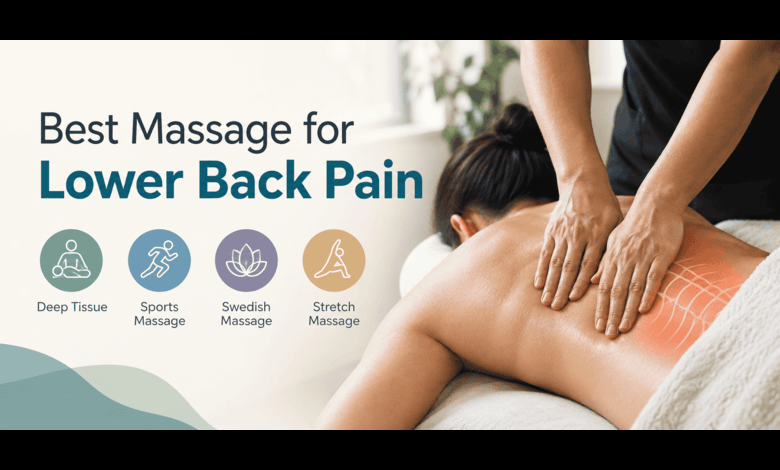
If you’ve been searching for the single best massage for lower back pain, the honest answer is that there isn’t one approach that works best for everyone. Lower back pain can have different contributing factors, and around 90% of cases are considered nonspecific, meaning there is no single identifiable underlying condition responsible for the pain. Massage may provide short-term improvements in pain and function for some people, but research has not established one massage technique as universally superior. The World Health Organization recommends that massage may be offered for chronic primary low back pain, while noting that the certainty of evidence is very low.
What matters is considering the nature of your symptoms, your individual circumstances, and the role massage can play alongside other appropriate approaches such as exercise. NICE similarly recommends considering massage and other manual therapies as part of a broader treatment package rather than as a standalone treatment.
But what is actually the best massage for lower back pain?
The answer depends on what is causing your discomfort, how long you have had it, how your symptoms behave and what you want from treatment. Deep tissue massage may be useful for muscular tension, while sports massage can make sense for people whose discomfort is connected with training or physical activity. A gentler Swedish massage may be more appropriate when relaxation and general muscular tension are the main concerns.
There is no single best massage that is right for everyone.
This guide explains the main options, what to consider before booking and when massage may not be the appropriate first step.
Is Massage Good for Lower Back Pain?
Massage can be useful for some people with lower back pain, particularly when muscular tension, stiffness or soft-tissue discomfort is part of the problem.
Importantly, massage should not be viewed as a cure for every type of back pain.
NICE guidance says manual therapy, including soft-tissue techniques such as massage, can be considered for low back pain with or without sciatica. However, it recommends that manual therapy forms part of a broader treatment package that includes exercise, with or without psychological therapy.
The NHS similarly lists manual therapy among treatments that may be recommended when back pain has not improved, alongside approaches such as physiotherapy and exercise.
That distinction matters.
Massage may help you feel less restricted, more comfortable or more relaxed, but maintaining movement and addressing factors contributing to recurring discomfort are also important.
What Causes Lower Back Pain?
Lower back pain has many possible causes.
Sometimes it follows a pulled or strained muscle. It can also develop gradually without one obvious incident. The NHS notes that conditions such as a slipped disc or sciatica can also cause back pain, while serious underlying causes are uncommon.
Everyday lifestyle can also influence how your back feels.
For example, someone might spend most of the day:
- Sitting at a computer
- Driving or commuting
- Working from a laptop
- Standing for long periods
- Lifting or carrying objects
- Training at the gym
- Running or cycling
- Travelling frequently
London’s working lifestyle can make several of these situations particularly familiar.
Long periods of sitting followed by a demanding workout, for example, can leave the body feeling stiff and uncomfortable. Stress and poor sleep can also affect how people experience muscular tension. That does not mean the pain is necessarily caused by one particular muscle or posture. Back pain is often more complicated than that.
Which Massage Is Best for Lower Back Pain?
For people whose discomfort appears to be muscular, several massage approaches may be worth considering.
1. Deep Tissue Massage
Deep Tissue Massage is one of the most commonly considered options for persistent muscular tightness and knots. It generally involves slower, more focused and firmer pressure than a relaxation massage. The massage therapist may work on areas around the lower back as well as connected areas such as the glutes, hips and upper legs.
The aim is not simply to press as hard as possible.
A skilled therapist should adjust pressure according to your tolerance and the condition of the tissues being treated. Excessive pressure is not automatically more effective.
Deep tissue massage may be worth considering if your lower back feels tight after:
- Long periods at a desk
- Repetitive physical activity
- Training
- Travel
- General muscular tension
- Stressful or physically demanding periods
Several London practices currently offer deep tissue massage specifically around muscular tightness, stiffness and back-related discomfort, reflecting how commonly this treatment is used in the city’s massage market.
2. Sports Massage
Sports Massage is not exclusively for professional athletes. It may be suitable for runners, gym-goers, cyclists and other active people who experience muscular tightness or soreness around training.
For example, someone who develops lower back tightness after strength training may want a treatment focused on recovery and mobility rather than a general relaxation massage.
Sports massage can involve a combination of techniques, including deeper soft-tissue work and stretching. The precise approach varies between practitioners.
It is also worth remembering that pain after exercise is not automatically a sign that you need an aggressive massage.
If you have sustained an injury, experienced a sudden change in symptoms or are unsure what is causing your pain, assessment may be more appropriate than simply booking a deep treatment.
3. Swedish Massage
Swedish Massage generally uses flowing strokes, kneading and lighter-to-moderate pressure. It may be a better fit for someone whose lower back discomfort occurs alongside general stress, fatigue and whole-body muscular tension.
Not everyone wants an intense treatment. If you have had a stressful week and your entire body feels tense, a relaxing massage may provide a more appropriate experience than asking for maximum pressure around one painful area.
London practices such as ARU NA UCHE offer Swedish Massage alongside deeper treatment options, allowing clients to choose between different approaches according to their needs.
4. Stretch or Assisted Stretching Massage
Some people experience lower back discomfort alongside a feeling of restricted movement.
In those cases, stretching-based treatment may be worth discussing.
Stretch massage and assisted stretching can be used to work with areas that feel tight or restricted. The emphasis should be on controlled movement rather than forcing the body beyond its comfortable range.
Again, the right approach depends on the individual.
Common Types of Massage for Lower Back Pain
| Massage type | Best for | Pressure | What it involves | Worth knowing |
|---|---|---|---|---|
| Deep tissue massage | Chronic muscle tightness, desk-related and stress-related back pain | Firm | Slow, sustained pressure into deeper muscle layers of the lower back, glutes and hips | The most common choice for persistent muscular back pain. Some soreness afterwards is normal |
| Sports massage | Pain from training, lifting or repetitive movement; keeping active people moving | Medium to firm | Targeted work on overused muscles, often with stretching and movement assessment | Not just for athletes. Good when the pain has a clear activity trigger |
| Swedish massage | General tension, stress-related aches, first-timers, sensitive clients | Light to medium | Long flowing strokes, kneading and circular movements to relax muscles and improve circulation | Gentler, so it may not reach deep, long-standing knots |
| Trigger point therapy | Specific tender “knots” that refer pain, such as in the glutes or the muscles beside the spine | Focused, firm on one spot | Sustained pressure on individual tight points until they release | Can feel intense for a short time. Often used within a wider massage |
| Myofascial release | Stiffness or restriction that doesn’t respond to standard massage | Light to medium, slow | Gentle, sustained stretching of the connective tissue (fascia) | Feels subtle. Results build over several sessions |
| Remedial / clinical massage | Recurring or longer-term back pain needing a structured plan | Varies | Assessment-led combination of techniques with exercise and posture advice | The approach matters more than the label, so look for a therapist who assesses first |
| Thai massage | Stiffness, limited flexibility, tight hips and hamstrings | Medium, with stretching | Assisted stretches and compressions, usually done clothed on a mat | More active than most massage. May not suit acute or severe pain |
| Shiatsu | Tension with a stress or fatigue component | Medium, using palms and thumbs | Rhythmic pressure along the body, based on Japanese tradition | Evidence for back pain is more limited than for mainstream massage |
| Cupping | Dense, stubborn muscle tissue | Suction rather than pressure | Cups create gentle suction on the skin over the tight area | Can leave temporary circular marks. Usually an add-on, not a standalone treatment |
| Hot stone massage | Relaxation and warming tight muscles | Light to medium | Heated stones used alongside massage strokes | Comfortable, but typically a complement to other techniques |
A note on evidence: research doesn’t show that one massage type clearly beats the others for lower back pain. NICE guidance says soft tissue techniques such as massage may be considered as part of a wider package that includes exercise, and not on its own. In practice, the skill of the therapist and how well the approach matches your pain usually count for more than the name on the menu.
When to see your GP first: numbness or tingling in the legs or groin, loss of bladder or bowel control, fever, or pain following a fall or injury need medical attention before massage.
What About Sciatica?
Sciatica deserves particular care.
Sciatica involves irritation or compression affecting the sciatic nerve and can cause pain that travels from the lower back or buttock into the leg. It may also involve sensations such as tingling, numbness or weakness.
Massage may be part of someone’s broader management approach, but it should not be assumed that massage is the appropriate treatment simply because the pain is located in the lower back.
If you have significant nerve-related symptoms, recurring symptoms or symptoms that are getting worse, consider speaking with a GP, physiotherapist or appropriate healthcare professional before booking a massage.
The distinction between ordinary muscular tension and a condition requiring further assessment is one reason responsible massage therapists should not promise that they can “fix” every type of back pain.
What Should You Look for in a London Massage Therapist?
Choosing a massage therapist involves more than finding the highest-rated treatment or the strongest pressure.
Consider the following.
Experience with your type of problem
If your main concern is lower back tension, look for a practitioner who regularly works with muscular and soft-tissue complaints.
A proper conversation before treatment
A good session should involve some discussion of your symptoms, medical history where relevant, activities and treatment goals.
Pressure that can be adjusted
Your treatment should not become a test of how much discomfort you can tolerate.
Clear boundaries
A professional therapist should know when a particular problem falls outside their scope and when another healthcare professional should be consulted.
Convenient location
London has massage providers across almost every part of the city, including Central London, the City, North London, South London and West London.
Some practitioners work from dedicated clinics, while others provide mobile massage at homes, hotels or offices.
Appropriate qualifications and professional standards
Qualifications vary between massage disciplines and providers. If you have a specific medical condition, injury or complex symptoms, you may prefer a service where massage is offered alongside physiotherapy or another clinical discipline.
For example, some London clinics now combine sports massage with physiotherapy assessment, while others focus specifically on massage and soft-tissue therapy.
Neither model is automatically right for everyone. The important point is understanding what service you are actually booking.
Can Massage Fix Chronic Lower Back Pain?
It is better to be cautious with the word “fix”.
Chronic or recurring lower back pain can have multiple contributing factors. Massage may help with muscular tension and provide short-term comfort for some people, but it should not be presented as a permanent solution.
NICE recommends self-management and continued normal activity for people with low back pain, with exercise forming an important part of management. Manual therapy such as massage can be considered alongside these approaches.
This means that if your back repeatedly becomes painful, it may be worth looking beyond massage alone.
Consider:
- How much you move during the day
- Your exercise routine
- Your strength and mobility
- Your recovery between workouts
- Your sleep
- Your work environment
- Whether symptoms are recurring or changing
- Whether you have been assessed by a healthcare professional
Massage can be one part of a broader strategy.
What Can You Do Between Massage Appointments?
What you do between treatments can be just as important as the treatment itself.
The NHS advises people with ordinary back pain to remain active and continue their normal daily activities where possible. It also recommends avoiding prolonged bed rest and suggests that activities such as walking, swimming, yoga and Pilates may help some people.
Simple habits can make a difference:
Keep moving
If you work at a desk, take regular movement breaks rather than remaining in one position for hours.
Build appropriate exercise into your routine
Strength, mobility and aerobic activity can all form part of looking after your back.
Pay attention to recurring patterns
If your back repeatedly becomes uncomfortable after particular activities, discuss this with an appropriate professional.
Don’t chase pain during massage
A treatment does not have to be painful to be useful.
Give your body time to recover
Exercise, sleep and general recovery all matter.
When Should You Avoid Massage and Seek Medical Advice?
This may be the most important part of choosing a massage for lower back pain. Not every back problem should be treated with massage.
The NHS advises speaking with a GP when back pain does not improve after a few weeks, interferes with daily activities, causes concern or is accompanied by symptoms such as unexplained weight loss, a lump or swelling, or changes in the shape of the back.
Urgent medical advice is recommended when severe pain starts suddenly or is worsening quickly, particularly if you feel generally unwell.
Call 999 or go to A&E if back pain is accompanied by symptoms including numbness around the genitals or anus, changes to bladder or bowel control, or significant weakness or numbness affecting both legs. These can indicate a serious neurological problem requiring urgent assessment.
If you are unsure whether massage is appropriate, it is better to seek professional medical advice first.
Where Can You Get a Massage for Lower Back Pain in London?
London offers a wide range of options.
You can find independent massage therapists, specialist sports massage practices, multidisciplinary clinics, physiotherapy practices and mobile massage services.
For example, ARU NA UCHE offers Deep Tissue, Sports, Stretch and Swedish Massage from its Marylebone location, with mobile treatments also available in parts of London. Its treatment menu includes several approaches that may be relevant to people experiencing muscular tightness.
Other London practices take a more clinically integrated approach, combining sports or deep-tissue massage with physiotherapy assessment where appropriate.
There are also independent remedial and sports massage practices focused specifically on muscular tension, recovery and soft-tissue work.
The best choice depends on what you need.
If your main priority is relaxation and general tension, a conventional massage therapist may be appropriate.
If you are dealing with a sports-related problem, a sports massage practitioner may make more sense.
If your symptoms are persistent, complex or potentially injury-related, a physiotherapist or multidisciplinary clinic may be a better starting point.
Choosing the Right Massage Near Me
Searching for the best massage for lower back pain in London can produce hundreds of options, but choosing the right one is less about finding the strongest treatment and more about understanding what your body actually needs.
- For muscular tightness, Deep Tissue Massage may be worth considering.
- For exercise-related tension, Sports Massage may be appropriate.
- For general stress and whole-body tension, Swedish Massage may be a better fit.
- For restricted movement, a stretching-based approach may be worth discussing.
And when symptoms are persistent, severe, neurological or unexplained, massage should not be the first assumption. A GP, physiotherapist or other appropriate healthcare professional may need to assess the problem.
The most useful approach is usually a combination of sensible self-management, appropriate movement and professional support when needed. If you are considering massage in London, take time to understand the practitioner’s approach, experience, treatment options and scope of practice before booking.
For readers specifically looking for a London massage provider, ARU NA UCHE’s treatment options provide one example of a practice offering Deep Tissue, Sports, Stretch and Swedish Massage. The practice is based at The Charterhouse Clinic on Crawford Street in Marylebone and also offers selected mobile massage services across London.
Ultimately, the right massage is not necessarily the deepest, longest or most expensive one. It is the treatment that is appropriate for your symptoms, your goals and your circumstances.
Frequently Asked Questions
What is the best massage for lower back pain?
There is no single best massage for everyone. Deep Tissue Massage may suit muscular tightness, Sports Massage may be useful for activity-related discomfort, and Swedish Massage may suit general tension and relaxation.
Is deep tissue massage good for lower back pain?
It can be useful for some people when muscular tension contributes to their discomfort. It should be tailored to the individual rather than based on using the strongest possible pressure.
Is sports massage better than deep tissue massage for back pain?
Neither is universally better. Sports Massage often has a stronger focus on physical activity and recovery, while Deep Tissue Massage generally focuses on deeper muscular tension. The two approaches can overlap.
Can massage help chronic lower back pain?
Massage may help some people manage muscular tension and discomfort, but recurring or chronic back pain may require a broader approach involving exercise, self-management and professional assessment.
How often should I have a massage for lower back pain?
There is no universal schedule. Frequency should depend on your symptoms, treatment response, lifestyle and the advice of your practitioner or healthcare professional.
Should I get a massage if I have sciatica?
Do not assume massage is appropriate simply because you have lower back pain. Sciatica can involve nerve symptoms, so persistent, significant or worsening symptoms should be assessed by an appropriate healthcare professional.
Is a painful massage more effective?
No. More pressure does not automatically mean a better treatment. A professional massage therapist should work within an appropriate and tolerable level of pressure.
Disclaimer note: This article is for general educational purposes and does not provide a medical diagnosis or individual treatment recommendation. If you have persistent, severe or unexplained back pain, or any of the warning symptoms described above, seek advice from an appropriate healthcare professional.
People Also Ask

Lynette Rae is a passionate writer who specializes in creating clear, engaging, and reader-focused content. With a keen eye for detail and a commitment to quality, she delivers insightful pieces that inform, inspire, and add value across a range of topics.